Who gets to look like a leader?
Years ago, a highly regarded speaker told me I should not speak about leadership.
His view was that leadership belonged to people with white hair. To generals who had led armies into battle. To CEOs who had led companies through crisis. People who had accumulated enough years and authority to earn the right to speak about what leadership really meant.
I understood the point. Experience matters. Responsibility matters. There is a kind of leadership forged through consequence, crisis and time.
But I remember thinking: who decided leadership experience had to look only like that?
By then, I had already started to see leadership differently.
For me, leadership does not suddenly begin when someone gives you a title. It can begin much earlier, when people trust your judgement, when you help someone move forward, when you bring people together around an idea, or when your actions influence the people around you.
You may not be leading an army. You may simply be helping the person beside you believe that something different is possible.
That still counts.
To me, leadership is influence before it is authority.
At 19, I had no idea where I was heading
When I was 19, I was studying Computer Engineering at Nanyang Technological University.
Even then, I suspected I probably was not going to spend my career in a deeply technical role. I enjoyed technology, but I was far more energised by people. I loved communicating, helping, connecting ideas and making complicated things easier to understand.
The problem was that I had no idea what kind of career that was supposed to become.
There was no neat path from computer engineering to the work I do today across cybersecurity, growth, strategy, community, speaking and leadership.
So I kept exploring.
I moved countries, tried different things and said yes to opportunities that did not always fit into a neat career plan. Looking back, I am glad I did not insist that every move had to make sense before I made it.
The thing I once questioned became a hidden superpower
For a while, I wondered whether studying computer engineering had been the right decision.
Eventually, I realised it had given me something incredibly useful. I understood enough of the technical world to speak its language, but I could also translate that world for business people.
That ability to bridge both sides became one of the defining strengths of my career.
I began working closely with Chief Information Security Officers and other technology leaders, initially helping them think about cybersecurity strategy. Through that work, I was also building relationships, communities, visibility and trust. Over time, I was helping build a brand and helping the organisation grow.
What looked like separate skills started to come together: technology, communication, strategy, community, growth, storytelling and relational intelligence.
My strength was not any one of them. It was the combination.
That journey eventually led me to become Chief Growth Officer of a global cybersecurity company. Later, it felt natural to take what I had learnt and help other organisations think about growth, positioning, influence and strategy.
There was no dramatic moment when I decided to pivot. It happened gradually as I learnt more about what I was good at and what people increasingly came to me for.
Sometimes a pivot is not about becoming someone different. It is recognising the person you have already been becoming.
When someone else has a narrower picture of what is possible
That conversation with the speaker stayed with me, not because I wanted to prove one person wrong, but because it revealed something I would encounter again and again.
People often judge what is possible based on what they have already seen.
If their image of a leadership speaker is older, male and battle-tested in a particular way, someone outside that image may feel wrong to them. If they have never seen someone like you doing something, their instinct may be to steer you back towards the lane they already understand.
Sometimes the advice is well-intentioned. Sometimes it is not. Either way, you have to decide how much authority you are going to give it.
I could have accepted that leadership was not a topic I had earned the right to speak about. Instead, I kept doing the work, building the evidence and showing that leadership can be experienced and expressed in different ways.
Over time, I also realised this was never really about proving one person wrong. The more meaningful outcome was being able to widen the picture of what leadership could look like, and hopefully make it easier for someone else to imagine themselves there too.
The bigger danger comes when someone else's definition becomes your own.
Someone questions whether you are ready, and eventually you start questioning whether you are ready. Someone tells you to stay in your lane, and after a while you stop looking outside it.
Eventually, nobody needs to tell you "you can't" anymore.
You do it for them.
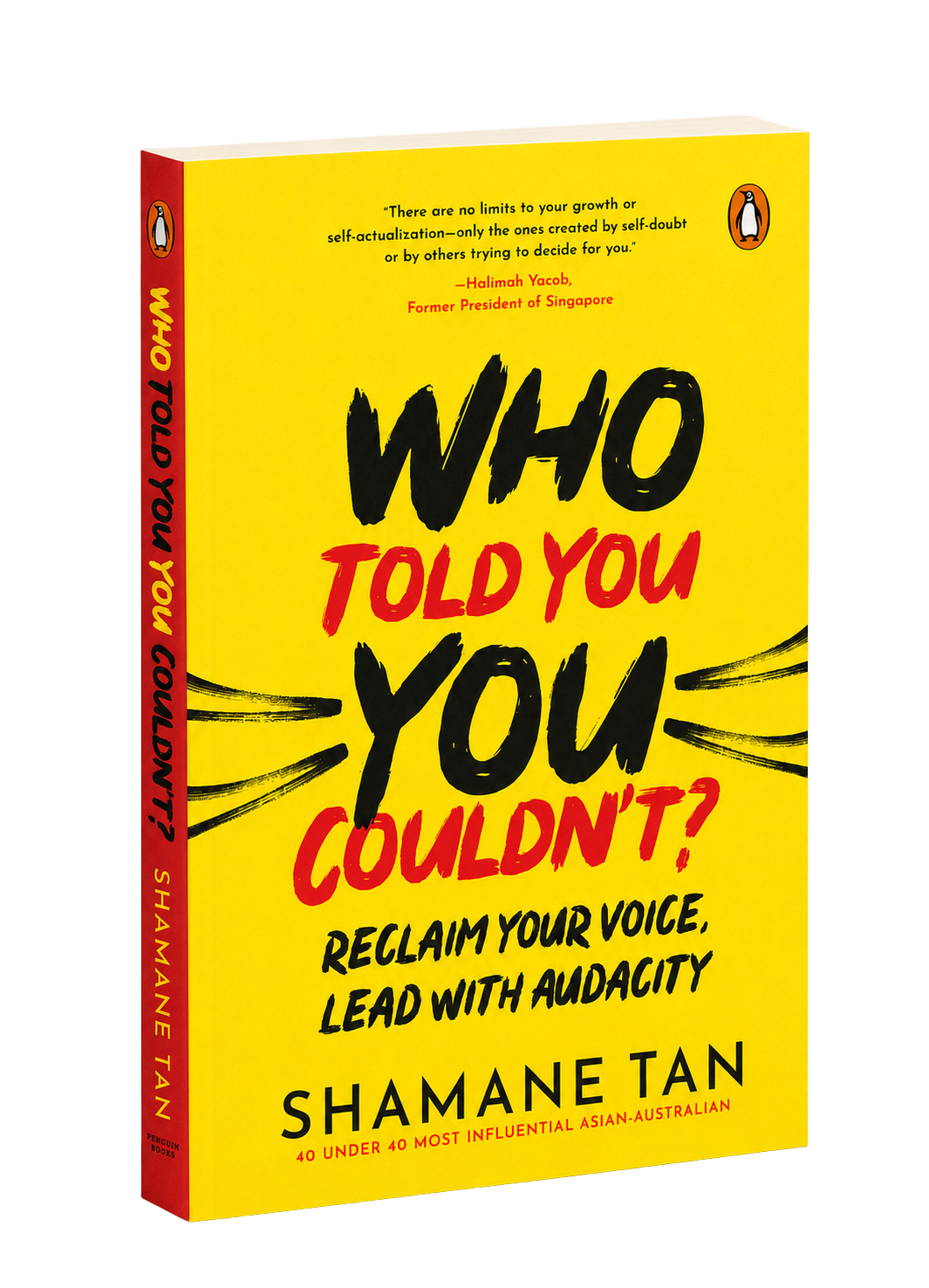
Why I wrote Who Told You You Couldn't?
That is one of the reasons this question became so personal to me.
Who Told You You Couldn't? did not come from one comment, one rejection or one person underestimating me. It came from recognising a pattern in my own life and in the lives of so many people I had met.
How easily other people's expectations can become our boundaries. How often we wait for permission. How quickly "not yet" can become "not me". And how much possibility can disappear before we ever test it.
The book is not about pretending doubt does not exist, assuming every dream will work out if we believe hard enough, or spending your life trying to prove critics wrong.
It is about becoming more conscious of which voices you allow to shape your decisions.
For a long time, I think I assumed resilience meant being unfazed. I see it differently now.
You can doubt yourself and still move. You can be disappointed and still move. You can question whether you belong and still choose not to let that doubt make the decision for you.
Resilience is not about never doubting yourself. It is about deciding that doubt does not get the final say.
That is also why I care so much about people learning to back themselves.
You can give others credit and still acknowledge your own contribution. You can be grateful and still be proud. You can be generous without making yourself smaller.
Backing yourself does not require diminishing anyone else. It simply means recognising that your own voice deserves a place in the conversation too.
One move is enough to begin
When people ask how to plan a career in a world being reshaped by AI and constant change, I do not think the answer is to predict your entire future.
Speak to more people. Learn what is possible. Stay curious. But do not outsource the decision about what matters to you.
Pay attention to what gives you energy, what you keep coming back to, and what people increasingly trust you for.
Then make one move.
That is an idea I have been exploring through AMBA. When the future feels overwhelming, you do not need ten moves. Sometimes you need one conversation, one application, one introduction, one decision or one moment of courage that creates momentum.
Much of my career was built that way. I could not see the whole path, but I could usually see the next door.
So if there is something you have been postponing because part of you still does not feel ready, you do not need to redesign your entire future today.
Ask yourself what the next move is. Make it, learn from it, celebrate it, and see where it leads.
Because maybe the question is not only:
Who told you you couldn't?
It is also whether you are still willing to let them decide what happens next.

Your story might be someone else's turning point.
Share what you were told — and what you did next.